

Selecting equipment that is fit for the measurement
Data loggers provide independent evidence of process conditions during Performance Qualification. However, a logger is not suitable simply because it is calibrated and capable of operating within the required temperature range.
Under AS/NZS 5369:2023, the measurement equipment used during validation needs to support the requirements of the applicable process standard. For steam sterilization this includes ISO 17665, while washer-disinfector validation is supported by the ISO 15883 series.
The appropriate measurement system therefore depends on what needs to be measured, where it needs to be measured and the process conditions under which the measurement is made.
Steam sterilizer validation
Performance Qualification of a steam sterilization process needs to demonstrate that the required sterilization conditions are achieved within the defined load, including challenging locations within reusable medical devices.
This makes sensor size and placement particularly important.
For complex RMDs, measuring chamber temperature may not establish when sterilization conditions have been achieved within the most difficult location of the device. The sensor needs to be capable of reaching the relevant measurement location without materially influencing steam penetration and/or heat transfer.
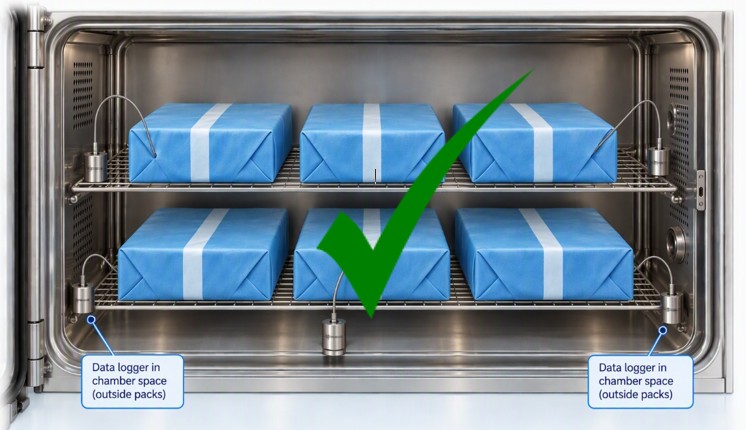
Data logging systems used for steam sterilization should therefore be selected with consideration of:
- suitability for saturated steam, sterilization temperature and pressure
- sensor dimensions and thermal mass
- ability to position the sensor at the required measurement location
- temperature accuracy and response time
- sampling interval
- relevant pressure measurement where required
- appropriate calibration and verification.
A logger that accurately records chamber conditions may therefore still be unsuitable for a thermal penetration study within a complex RMD.
Washer-disinfector validation
Washer-disinfector validation presents a different measurement environment.
The ISO 15883 series requires assessment of defined process conditions during cleaning and thermal disinfection. Unlike steam sterilizer PQ, measurements may therefore be important across several stages of a changing process:
pre-rinse → cleaning → rinsing → thermal disinfection → final rinse → drying
This means the logger needs to perform reliably across the relevant temperature range, including the lower temperatures associated with cleaning as well as the higher temperatures used for thermal disinfection.
Instrumentation also needs to withstand exposure to:
- water and direct spray action
- detergents and process chemistry
- repeated heating and cooling
- thermal disinfection conditions
- mechanical movement within the load.
Sensor placement should provide representative measurements across the chamber and load and remain secure throughout the complete wash cycle.
Calibration must match the application
A current calibration certificate is important, but calibration alone does not demonstrate that a logger is suitable for a particular validation test.
The calibration should be relevant to the temperature range over which the measurements will be relied upon, with appropriate consideration of:
- calibration points and range
- measurement accuracy and uncertainty
- sensor identification
- reference traceability
- verification required by the applicable test standard.
This distinction is particularly relevant when the same data logging equipment is proposed for both sterilizers and washer-disinfectors.
A logger demonstrated to perform appropriately at steam sterilization temperatures should not automatically be considered suitable for washer validation at lower cleaning temperatures simply because those temperatures fall within its stated operating range.
Operating range is not the same as demonstrated measurement suitability.
Wired versus wireless systems
Both wired systems and self-contained wireless loggers can provide valid measurement evidence. Neither is inherently suitable for every application and in some instances, both may be required. Eg: to conduct Chamber Wall Temperature Tests, attaching sensors to a chamber wall of a washer-disinfector may not able to be achieved using wireless loggers, therefore compliant testing of a washer-disinfector would require both wired and wireless loggers.
Wireless loggers can simplify placement throughout equipment chambers and loads, but their physical dimensions and thermal mass may limit their suitability where measurements are required within small or complex RMDs.
Wired or remote-probe systems can allow much smaller sensors to be positioned within restricted locations, although cable routing and installation introduce different considerations.
Selection should therefore follow the measurement requirement, rather than a preference for a particular logger technology.
Selecting the logger for the test – before selecting data logging equipment, consider:
- Is the logger compliant with the test equipment specifications of the respective Standard?
- What must be measured?
- Where must it be measured?
- Can the sensor reach that location without influencing the process?
- Is its accuracy and response appropriate for the acceptance criteria?
- Is its calibration relevant to the temperatures being assessed?
- Can it withstand the process environment?
- Does it satisfy the applicable validation test requirements?
- Can the resulting measurement be clearly traced to the logger, calibration record, test location and PQ result?
There is no single data logger that should automatically be considered suitable for every validation application.
The important question is not simply:
“Is this data logger calibrated?”
It is:
“Is this measurement system suitable and appropriately calibrated for the process, measurement location, test methodology and acceptance criteria being assessed?”
Selecting the measurement system from the test requirement provides stronger and more technically defensible evidence to support Performance Qualification.
How SVA can help
SVA understands that reliable validation depends on more than selecting and positioning data loggers. The instrumentation itself must be fit for purpose, with appropriate specifications, accuracy, resolution, calibration and traceability for the process and conditions being assessed.
Drawing on specialist validation knowledge and practical experience, SVA selects and applies instrumentation appropriate to each application, including the required operating range, response characteristics, sampling requirements, sensor placement and acceptance criteria. This ensures the resulting data provides reliable and technically relevant evidence of process performance.
This publication contains original content developed by Sterilizer Validation Australia and may reference third-party standards, guidelines and other published works. Copyright in those referenced works remains with the respective copyright owners.
SVA content may be shared in its original, unmodified form with appropriate acknowledgement. Reproduction, modification, adaptation or commercial use of SVA content requires prior written permission from Sterilizer Validation Australia Pty Ltd.
Copyright © 2026 Process Validation & Design Pty Ltd T/As Sterilizer Validation Australia [SVA]. All rights reserved.
 Article
Understanding Water Quality in Reusable Medical Device Reprocessing
Water is a critical input to reusable medical device (RMD) reprocessing. It is used for cleaning, rinsing and thermal disinfection, and as feedwater for the generation of steam used in sterilization.
Read article
 Article
A Guide to Performance Qualification under AS/NZS 5369:2023
Performance Qualification (PQ) forms part of the validation of reusable medical device reprocessing processes.
Read article Article
When Device Protection Creates a Cleaning Challenge
During Performance Qualification of an automated cleaning process for flexible endoscopes, SVA identified cleaning efficacy failures associated with the way the devices were being presented within the washer-disinfector.
Read article